Construction Muck and Grout Waste

Firm up wet excavation muck, grout returns and concrete washout so they stay in the skip and leave site cleanly.

Cement-bearing site waste is one of the harder streams for a superabsorbent polymer, because it is strongly alkaline and rich in dissolved calcium. AuraChem screens grades against your actual washout or grout, so the product chosen still performs in that chemistry.

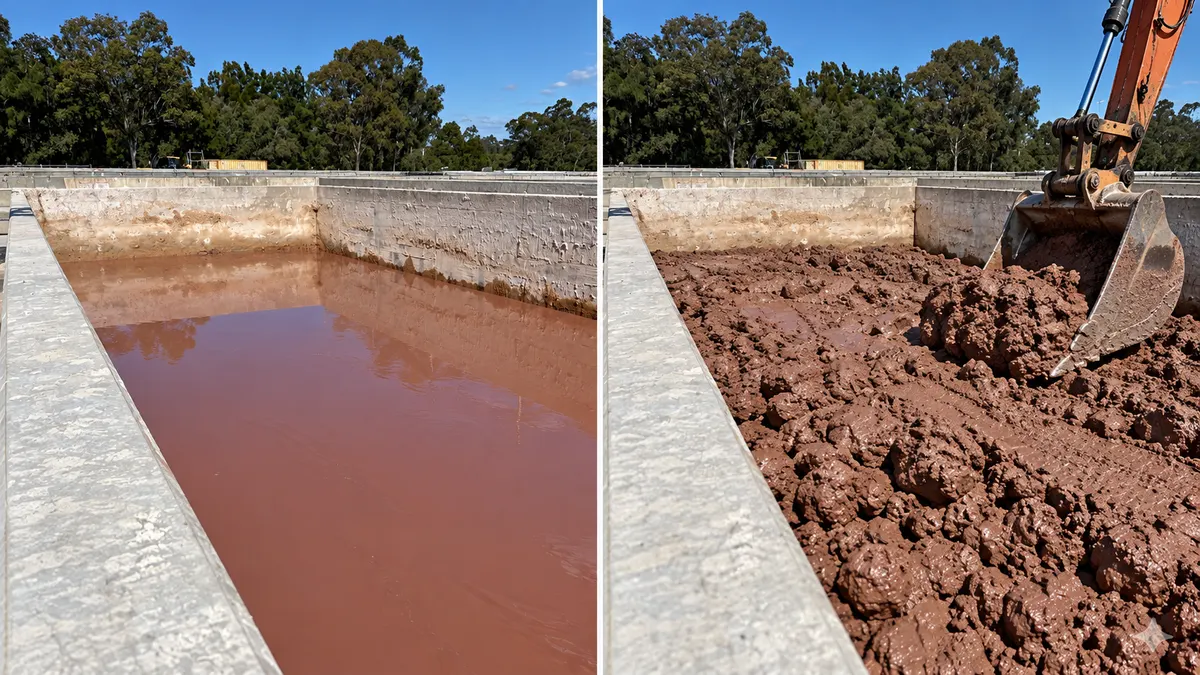
Construction muck before and after treatment in a containment pit

What Ends Up in the Washout Bay

On a typical civil or building site, wet waste arrives from several directions at once: concrete truck and pump washout, grout return from anchoring or injection work, saw-cutting and core-drilling slurry, and muck dug out of footings and pits after rain. Each has a different balance of free water, cement fines, sand and clay.

Keeping these streams apart where you can is worth the effort. A skip of clear-topped washout and a skip of dense grout return need very different amounts of polymer, and tipping an unknown stream into either makes both harder to treat and harder to classify.

Why Cement Chemistry Works Against Standard SAP

Fresh cement paste releases calcium hydroxide, which is why concrete washout water is strongly alkaline, often above pH 12, and carries dissolved calcium. Sodium polyacrylate swells by drawing water into a network of charged carboxylate groups. Divalent calcium ions bridge those groups and pull the network tight, so a general-purpose grade can hold far less here than its clean-water rating suggests.

Grout admixtures such as plasticisers, retarders and accelerators, and the bentonite used in some grout mixes, add further variables. The slurry also keeps stiffening on its own as the cement hydrates, which changes how much water is still free to capture by the time treatment happens.


Locking Up Washout Water Before the Cement Sets

Polymer is spread through the wet material while the water is still mobile. The granules swell into pockets of gel that hold that water, and the cement fines and sand around them become a crumbly, stackable mass that no longer pools in the bottom of a skip or runs when it is tipped.

Timing matters more on construction waste than on most streams. Treating washout soon after it is generated, before a set crust forms, gives the polymer access to the water it needs to capture and avoids having to break up partly hardened material later.

Setting Up Treatment on a Construction Site

  1. 01Map the wet streams. List where washout, grout return, saw slurry and wet muck are generated and how each is collected today.
  2. 02Sample each stream as it is produced. Fresh and day-old washout behave differently, so note the age of every sample.
  3. 03Run a calcium-tolerant screen. Compare candidate grades in the actual washout or grout rather than tap water, recording the free water left after a set contact time.
  4. 04Pick a mixing method that suits the container. Layering polymer as a skip fills, working it in with an excavator bucket or blending in a mixing bay each suit different volumes.
  5. 05Check the result before collection. Confirm no water drains when the material is disturbed and that the waste contractor accepts the treated form.

Choosing a Grade for High-pH, High-Calcium Waste

Relevant ProductAuraSorb 4000 Series
When It May Be SelectedA practical starting point for washout and wet muck. The Rapid profile suits bins collected soon after filling; the Standard profile suits waste that sits longer before pickup.
Application-Rate ApproachDose is set from the free-water volume of a settled sample of each stream, then adjusted on site as washout volumes change from pour to pour.
Relevant ProductAuraSorb 8000 Series
When It May Be SelectedWorth testing on dense grout return and cement-rich slurry, where a firmer, drier-feeling result is needed for stockpiling or tipping.
Application-Rate ApproachTrialled side by side with the 4000 Series in the same cement-bearing liquid, so the extra retention can be weighed against the amount used.

Site Factors That Change the Amount Needed

Calcium and pH of the liquid
Divalent calcium is the main reason cement waste needs more polymer than clean water
Age of the material
Older washout has less free water and may have begun to set
Washout, grout or muck
Free water ranges from most of the volume to a small fraction
Admixtures and bentonite
Plasticisers, retarders and clay in grout mixes alter how water is held
Skip or bay geometry
Deep, narrow bins are hard to mix evenly; shallow bays are easier
Collection frequency
Short dwell times favour faster-acting profiles

Practical Gains for Site Managers

These are potential operational benefits subject to material testing and field or production validation.

Skips and washout bins stop sloshing and leaking during lifting and transport

Treated muck can be stockpiled or tipped rather than pumped out as a liquid

Far less bulk added than sand, sawdust or soil used to firm up wet waste

Easy to keep on site for intermittent pours and wet-weather muck

What a Construction Waste Screen Reports

For each stream sampled, the report records the grade that held the cement-bearing water, the amount used per unit of waste, how quickly free water disappeared and what the treated material looked like after standing. It also flags streams where calcium or admixtures cut performance far enough that a different grade, or keeping the stream separate, makes more sense.

Grout and Washout Treatment Questions

Why does SAP absorb less in concrete washout than in tap water?

Washout is alkaline and full of dissolved calcium from the cement. Calcium ions bridge the charged sites inside the polymer and stop it swelling fully, so more product is needed than clean-water figures suggest.

Should washout be treated straight away or left to settle?

Treating while the water is still mobile gives the best contact. Where site rules allow, settled washout can have clear water decanted first, leaving a smaller, denser volume to treat.

Can grout return and wet excavation muck share a skip?

They can, but they dose very differently. Keeping them separate usually means less polymer overall and a more predictable result for each skip.

Can polymer be added while the skip is being filled?

Often, yes. Sprinkling polymer in layers as washout goes in spreads it through the load without a separate mixing step, provided each layer is wetted through.

Is solidified concrete washout still regulated waste?

Yes. Treatment changes how it handles, not what it contains. Where it can go is decided by the receiving facility and the relevant state EPA requirements.

Related Site Waste Applications

Test Your Washout or Grout Waste

Send a sample of the stream that gives you the most trouble and we will screen calcium-tolerant grades against it.

AuraChem

Application-specific superabsorbent polymer solutions, stocked in Australia and supplied nationwide.

Need product or application support?

Talk with our team about product selection, samples, quotations or technical requirements.

Contact Us
© 2026 AURACHEM · AUSTRALIAN SAP SUPPLIER